Sunday, 21 March 2010

One Hundred and Eighth : Life is Hard


Sent to you by D via Google Reader:


via "Les Confessions" on 01/08/05

The other day, while on a caffeine high (alas, all other forms of stimulation have been exhausted) I decided to become competent at my job. All the bothersome tasks that had been troubling me for weeks (or months) were to be confronted. And one by one they fell with the speed and manner of the 20th Centruy French military when faced with anything better armed than a Vietnamese rice peddler. And I realised, my job, obviously - isn't that difficult. If I wasn't such a spaz then I'd almost never be under any stress or pressure. Sure, I'd be doing difficult and complicated tasks, but on the whole work would be reasonably easy.

And this, as always, got me thinking.

Bastardising the point somewhat Marxists argue that the economic system will have an affect on the values held by a given society. This is obvious, but in simplest terms might mean that notions of (say) honour and loyalty or duty will tend to dominate a feudal society, but ones of efficiency and materialism will dominate in a capitalist society.

Bertrand Russell went on to say that the sexual ethics held by an individual might reflect the economic system of his or her grandfather. That is, these things "lag", and we might hold a bunch of beliefs / values which don't really fit current realiites. This is kind of obvious of course, and if you look at religions they are full of this sort of thing. Eating pork at one point may have been a bad idea for hygeine reasons, but now there's not as much of a problem. Yet people still refuse to eat pork. A belief outlives it's usefulness.

And that's what I'm talking about here. Specifically, the notion of hardship, in all it's forms. That life is (or should be) hard, or difficult, or troublesome. Woody Allen in "Annie Hall" says :
I feel that life is divided into the horrible and the miserable. That's the two categories. The horrible be like, I don't know, terminal cases, you know, and blind people, crippled. I don't know how they get through life. It's amazing to me. And the miserable is everyone else. So you should be thankful that you're miserable, because that's very lucky, to be miserable.

I for one used to live by this sort of ethic. Life is nasty, brutish and short to quote Hobbes (the non-tiger one). Existence is pain.

And of course, this is very true for a great number of people. For many people life is horrible. There is hunger, poverty, war, crime, disease, etc. Opening my browser and going to news.bbc.co.uk I read about terrorist bombers, a kid who was killed with an axe through his head for nothing in particular, a guy who was stabbed on a night bus over something just as trivial . At any one moment it seems fair to assume that there are hundreds of thousands of people in physical agony and many millions more suffering some kind of severe distress over the prospect of pain/hunger/etc. So I guess that's the horrible.

What of the rest? No doubt there is a great deal of misery. Apparently millions of individuals in America are on anti-depressants and the ones that aren't might be killing themselves or at least contemplating it. We are told that suicide and self-harm (surely some signs of existential despair?) are rampant and rising in segments of our youth, seemingly unchecked by iniatives to curb them.

But even on a more mundane level, life is generally acknowledged to be hard or difficult. But why? Should every day be some ceaseless struggle? Is there an actual reason, or are we just presuming that this is how things are?

It's strange, because this concept has survived (possibly because of the "lag" described previously) beyond actual conditions of (economic) hardship. In only a couple generations the standard of living for a great number of people (in the developed world) has vastly improved. To take a few quick examples ; my mother was brought up in rural Ireland. From what she used to say, they used to use a mangle to "iron" their clothes. Not a hardship per se but gives an idea of the level of development. My father had to leave school at 14 to get a job to help support his family. My mother-in-law spent some of her childhood in a corregated iron roofed shack in District Six. The point is that barring some economic collapse or just rank stupidity they are conditions that my hypothetical children are unlikely to have to live through.

Which is good, obviously.

But we don't seem to have got past the notion of 'hardship'. Despite everything getting better and better (for some) we carry around some bizarre racial memory that things should be difficult. This seems like a strange point to make, I realise. And indeed, on the face of it - who gives a shit?

Perhaps the easiest way of explaining this sort of concern is to give an example. As most of you will be aware, I live with four other individuals in a shared house in South East London. There are three males and one female. I will put my hands up and say that I am one of the laziest, dirtiest, smelliest, disgusting individuals you could hope to meet (or not as the case might be). My housemates are on the whole not particularly dirty or messy, but my housemates don't care enough about the mess to do anything about it. Or so it seems.

So anyway, predictably the house falls into a gradual decline whereby plates, cups, etc get left everywhere. Mould grows. Chicken boxes fester away under the sofa. Ants routine patrol our front room floor collecting morsels of rubbish to feed their ever growing ant-empire. There is a smell that is ever present but somehow undefinable / untracable. And so on. You get the idea - I'm sure most of you know a household that fits the description.

Now, no-one who lives here is particularly happy with the situation (I suppose) but you stop noticing after a while. It's only when someone visits for the first time in a while that you realise how things are. One person said that they don't think they could live in such a state. And they're not a particularly tidy person.

So you get used to it. For the people inside the house, it's normal. I mean, obviously there's ants on the floor. Why wouldn't there be? Yes, that pizza box has been there a month. It's difficult to comprehend how things could be any other way.

What we're used to is what we expect and what we expect influences what we try to change or challenge.

So life, is hard. How does this affect things? Let's have a quick look at a couple of examples.

1. Relationships

I'm sure most of you will have heard at one time or another the idea that relationships are hard work. And I'm not just talking about romantic relationships. Whether it's a marriage, a working relationship, a boyfriend/girlfriend a flatmate or lesbian life partner you might hear the refrain that "it's hard work". Or that you need to work hard to keep it working. I've never really understood why.

Don't get me wrong - I've been in relationships which have been hard. Monstrously hard in fact. But you know why that was? It was because one or more people involved were jerks. True story. Take something like :

"It's hard sharing a living space with someone"

No. It's hard sharing a living space with someone if one or more of you are arseholes. Unless you're sharing a coffin or a shoe box then it's not difficult putting up with someone else. Unless you've got some strange psychological problems of course.

"I've had a few problems with my boyfriend. I guess it's hard getting used to other people's little ways, you know?"

No. It's hard getting used to your boyfriends ways because he likes putting cigarettes out on your back while he wanks over pictures of your sister. There is nothing inherently difficult in adjusting to a new person unless you or they are unreasonable (or merely mismatched). Putting up with someone cracking their knuckles, or taking ages in a shop - these are not difficult things, unless you've got some major problems yourself.

Relationships do not need to be difficult. They do not need to be hard work. They are not assignments. They are not prison sentences. Hard work is exactly what they shouldn't be. If you find maintaining a relationship with someone difficult, think about why this might be. For instance, I find it difficult to get on with my mother. It could be because we're not putting in the requisite amount of effort, or it could be the more likely explanation that I am a self-centred cunt and she is crazy.

Even something like raising kids doesn't need to be difficult. People lose their tempers all the time with the kids (unacceptable imo) and then fall back on the comforting idea that it's meant to be hard. It's not. You're just broken. (Yeah, I know, check out the self-righteous prick with no kids of his own)

2. Work

I've already talked about this, and many of you know my feelings on the subject more generally. There are a lot of ways modern work can be criticised. For instance, more eloquently than I am capable of, T&F wrote here :

Working is also losing all meaning, anyone reading this, ask yourselves what you do, how is it helping, can you trace it back to any sort of useful production or investment in society, sure in its own context, but really what's the point of any of you. Ask yourselves if you are completely irreplaceable. Ask yourselves if you actually look at your job as a cruel form of torture which interrupts things you would rather be doing.

But it's not just that. It's not just the politics. It's also the efficiency.

The broad area of work I am in, as I have mentioned previously, is housing maintenance. "We" (in the loosest sense) repair people's homes and make sure they have a decent place to live. It might be a repair to a dripping tap, or making sure their windows are wind and water-tight or any number of things. The things that come our way are varied.

In one case we're dealing with at the moment, we're knocking through two houses so a 23 year old woman and her twelve children (see here) can have a home which is of a more appropriate size. In another, we're making sure an elderly couple have an appropriate heating system before it gets to winter. And so on. The point is that even if you oppose welfare systems on principle or housing associations as a method of service delivery it's reasonably "worthwhile" work with socially desirable ends.

So, that's all good. But...things are pointlessly difficult. Bizarrely stupid procedures are if not actively encouraged then completely tolerated. People are encouraged to put up with stupidity in systems which easily double or treble the amount of work needed. This is not a call for idleness - this is a call against stupidity and complacency.

I could give you fifty tasks at my work which are unreasonably difficult. For instance, we have 12,000 properties with about 12 officers looking after the tenants (each with a patch, obviously, of about 1k properties). Finding out which officer deals with a particular property or road is curiously difficult. I have witnessed 4-5 phone calls and various e-mails about answering just that. Most people just shrug their shoulders at this- what else are we going to fill our time doing? It couldn't be any other way...

As it is with software. Simple tasks that should be one/two clicks away are incredibly convuluted. Lazy (or merely ignorant) software designers happily allow users to carry out tens of thousands of unnecessary man hours of work because they can't be bothered to explore alternative ways of doing things. And of course, no-one challenges it because, well - that's life. Things are expected to be shit or annoying.

Of course, if you want life to be hard, that's cool. If you want to drive yourself then bravo. Projects or activities can push you to your limits (or beyond if you like) can only be encouraged. Climbing Mount Everest - that should be hard unless you're some sort of ninja. Taking the stairs instead of the lift at your building, well - if that's hard then you're probably a fat bastard (or suffering some sort of disease).

Life, on an everyday level, should not be hard. If it is then something's wrong. Try and fix it. If everyday life is hard how the fuck are you going to cope when something genuinely horrible happens?


Things you can do from here:


One Hundred and Seventh : Think Big About Your PC


Sent to you by D via Google Reader:


via "Les Confessions" on 27/07/05

After my recent complaint about not having any time it seems logical that I went out and bought World of Warcraft which has got to be one of the biggest time sinks in Christendom. The reason (/quasi-justification) for this was that
a) I had just got a new PC (for cheap...sort of)
b) I had just received our new annual bonus so got paid slightly more than I usually do.

OK, that's no real excuse but I wanted to be in on the fun, and it does seem rather good although I've not got to play it properly yet. Because of that this is a short entry.

Tiny 2002
Tiny 2005


I mention this because I used to work for Tiny (well, indirectly) and lost my job as part of the first stage of this saga in 2002. The company sold cheap, nasty PC's which were under-specced. Their support service wasn't particularly good and there wasn't anything that seperated them from the competetition. In customer satisfaction surveys they generally came second bottom (to Time, who came bottom). They were then bought by Time, as the article then shows.

It's not particularly interesting but the computer mentioned above that I got today came from Dell (the world's number 1 PC reseller I believe) and represents the first desktop PC I have bought since 1998. The one I bought back way back then was a Tiny PC.

And this isn't really related to anything, but I think this was ace:
The Daily Express, 27th July 2005

There really is nothing I have to say about this.

The Computer For Staff Scheme

Speaking of spongers, I was recently reflecting on working in government / quasi-government and the wastage therein. Most people seem to know at least one or two people who work for the state (be it in education, the civil service, the health service, etc) and I bet you that if you ask the person you happy to know they could give you at least 3 absurd wastes of money they personally witness on a regular basis. This makes all sorts of people very angry - why are our taxes wasted on such crap?

Well, damned if I know. Still, as recent court decisions have shown, you can't opt out of taxes so I suppose we should pay attention to these things. After all, if we don't pay taxes we can go to jail, and hell who in London wants to be an enemy of the state these days?

But the thing is that it can be easy to focus on the negative. Shiftless wasteful government employees, foriegn wars that the majority oppose, single mothers who have lots of illegitimate criminal children and suicide bombers who have the audacity to claim welfare benefits before trying to blow up Oval station (although it might be worth noting that it's often illegal for asylum seekers to work under the existing system). Wherever we turn it seems "our" taxes are going on dubious causes.

But not all taxes are a waste. A lot of them go to worthwhile things. Like purchasing Anthrax vaccines (which ultimately goes to people like me) and the recent Computer for Staff iniative.

Basically, the government has launnched a new scheme whereby you can buy a PC via a "salary sacrifice" which means you pay less taxes. So for instance, my new PC is costing me £28 per month for three years. So £1008. However, because I'm paying that before tax, I actually end up paying less tax so it's actually £16 per month or £576 per month. So the government is subsidising my PC purchase by £500, indirectly.

Which all sounds grand. Except that...as far as I can tell, my PC isn't worth a grand. It's worht about £500 (according to recent Dell prices). The PC at it's set price would be completely uneconomic for me to buy, if it wasn't for this government inducement.

All this means, in a round-about way that the government are paying Dell (which as I mentioned aren't doing too badly) £500 for doing fuck all.

So you see, your taxes do go to a worthy cause in some cases. After all this guy has gotta eat you know.


Things you can do from here:


One Hundred and Sixth : Tick, Tock and The Old Man Died


Sent to you by D via Google Reader:


via "Les Confessions" on 19/07/05

Guys Drugs Research Unit

On Saturday I had my first dose of what I presume is anthrax vaccine. I don't know for sure because one of the five injections they give you is placebo (to see if you're some sort of faggot that would scream bloody murder after being injected with saline or whatnot) but obviously it's not clear which one. There were no observable side-effects, except for a slight case of dry mouth which passed within half an hour or so.

Basically the process goes something like this :

Saturday 16th July : 16 blood samples (!) + injection

Saturday 23rd July : More samples + injection

Saturday 6th August : More sample + injection

Saturday 20th August : More samples + injection

I then get another injection after six months, plus a bunch of other tests and that's about it. I think. There's quite a few more appointments where they just test your general health. I'll let you know if I die.

After the blood letting and the injection I went to a party (Hesters), then clubbing (Slimes) where I took some drugs. I will only say this : losing a small amount of blood is a good fucking pre-roll.

Time

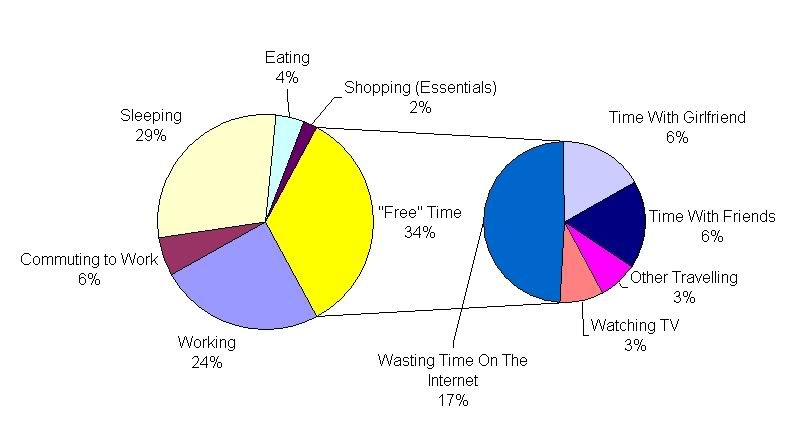
I've recently felt like I've got no time to do anything. This is a reoccuring theme in my life although I'm not sure why. Most of my time seems to be spent doing very little at all. In fact, here's something that could only be made more gay by the use of Power Point :


Here I am of course referring to exclusive activities. A lot of my time spent wasting time on the internet is also spent at work, and I'm not including things like "listening to music" since it's very rare that that is all I am doing (so I might be listening to music while commuting or something like that).

I've subdivided the right hand side into the things which seem to be more optional activities - that is where I think I have a reasonable degree of control (I could vary the amount I do any of them without considerable hardship).

But I don't really know where I should spend more time. On one level I should take things easier and spend more time with friends/relaxing, but from another perhaps I should work harder in my job or spend more time writing. Who knows?

Even if you can narrow these things down to one thing (e.g. I will dedicate all my life to playing the guitar) then there's still a whole range of sub-issues. Do you spend all your life learning acoustic or electric? Do you join a band or just try to become individually excellent? What songs do you try and learn? What style of guitar playing? Etc, etc. Obviously all of this is just taste, but there's also a moral issue. Where _should_ you spend your time?

That, in a round-about way is kind of what I've been thinking about lately. And so I let my mind wonder on the subject.

"Fuck Natalee Holloway", Bending the Stick And Other Issues

As seen above, I waste a lot of time on the internet. The sites I've visited today include :
-- The Planetarion Forums
-- Livejournal
-- Slashdot
-- The Register
-- ZNet
-- Monthly Review
-- The Economist
-- Google News
-- BBC News
-- IR London
-- Kuo5hin

Plus some private and work related sites (how worthwhile your job is can be directly measured by how many times you have to check the Office of the Deputy Prime Minister Website in a month).

One of these, Kuro5hin, a tech and cultural site recently carried a story which was entitled "Fuck Natalee Holloway". The story can be found here, but basically can be summarised that the US Media have gone (or went) over-the-top in their coverage of an individual case of a missing person. A young girl on holiday on a foriegn island went missing, big deal of it made in the media. Kuro5hin was posting the natural counterpoint : "We don't care". Well, it wasn't that harsh. Basically they were talking about the disproportional nature of the coverage compared to the many other disappearances of young children - many of whom are young, poor and non-white (the story gives the example of a girl called Reyna Alvarado-Carerra).

Of course, anyone who has watched TV news or opened a newspaper before will not be surprised by any of this. Some things are hyped up beyond all belief and other things go strangely unnoticed. One death results in a thousand columns, another in none at all. One of my friend's neighbours was murdered and I don't recall seeing a single mention in the newspapers about the incident. At the other end of the spectrum who can forget the stupidly over-the-top reaction the death of Diana Spencer?

Most of the time it's fairly obvious why certain things get more coverage than others. Tony Blair being killed warrants more coverage than me getting killed not because he is a better human being (well, possibly) but simply because his death has more of an impact and he is known to more to more people and therefore his death of more interest to more people.

There are also plenty of other (equally obvious) reasons for different (but similar) stories getting disproportionate coverage. I've sketched a few examples with very crude explanations for each :

Political / Structural Bias
The people who control / own / dominate the media have a vested interest in reporting specific types of stories. See Manufacturing Consent or any number of Marxist Media theories.

Cultural Bias
Different groups are (unsurprisingly) going to have varying degrees of sympathy depending on the source. This works on all manner of levels but for instance; a recession which affects middle class people will perhaps be of more interest to journalists (of a generally middle class persuasion) than one which effects coal miners or what-not. Britains are more likely to care about Australia than (say) Japan because of the cultural links which exist.

Practical Constraints
A disaster in London is going to be nearer to more journalists than a disaster in the North of Scotland. Rather simplistic, but you can see the point. A disaster in New York will guarantee many thousands of cameras on it, a disaster in Congo less so.

Inertia
"It's the news not because it's important but because our coverage makes it important" as an episode of Duckman once said. Once something has been in the media for long enough, regardless of how irrelevent it was in the first place then it becomes legitimate news. The BBC generally features on the news (for instance) who wins Big Brother to give an obvious example.

Fashionable Issue / Case Study
When my friend's neighbour was killed, there wasn't a lot to be said. Wife stabs husband. There was no bigger picture to see, no case study to develop. A simplistic view would be "Oh well, they were poor and black South Londoners, who cares if they died" but that doesn't explain Daimola Taylor or Steven Lawrence. But of course, they were case studies (of urban blight and police/societal racism respectively)

The People Involved Won't Shut The Fuck Up
In many instances, it's just the determination of those affected which get's and keeps the media spotlight on their case.

And so on.

The reason why I bring all this up is because it's something that occurs to me as a key element to the time question. The media have their reasons, as shown, for giving more coverage to one than the other. But what of us, as moral agents? We only have a limited amount of time on our hands, or energy in our bodies, or grief in our soul. What do we do with it? Should we pay as much attention to Natalee Holloway as we do to Reyna Alvarado-Carerra? They are both human beings, they are both equally distant from ourselves. I've never met either of them, nor any member of their families nor (in all likelyhood) anyone who ever met either of them. Or do we pay more attention to the one most like us?

Noam Chomsky says he writes almost exclusively about the crimes of the United States (and her allies) because that is an area where he (and his readership) can have an influence - rather than condemnation of enemy countries many miles away where we lack such influence. This unfortunately does not help us with purely domestic issues or with the Natalee case above.

This issue came up recently with the two minute silence held on Friday 15th July. There are many things that can be said on this subject, but I will limit myself to one argument I have heard from a number of people : what about other victims? Where are the silence for the victims in Iraq who have been killed since (or before) the invasion? Where is the silence for those dying needlessly of hunger or AIDS or whatever else? Where is the silence for...etc, etc.

You get the idea. I mean, if we wanted to be simplistic, we held a two minute silence for fifty five or so people killed in London. A story on the BBC News today says 25,000 civilians dead in Iraq since the invasion. So, on the same scale we should have 15 hour silence for Iraq. I believe Fidel Castro said in the 80's that if we were to have a minites silence for every child who needlessly tired of hunger the Year 2000 celebrations would have been silent.

This line of argument can be objected to on at least three grounds :

- Obviously we are going to be more affected / focussed on deaths in our country for a range of reasons. If there is an explosion on the tube (a service we/our families might use every day) then quite naturally we are going to take this to heart than some far-off disaster. This is undoubtedly true, but then again we held silences for the 9/11 victims (many thousands of miles from ourselves).

- Silences are a general time to reflect on all victims of violence / poverty and no-one was saying we should restrict our attention to one set of people. This is also true, but these things are never marketed this way.

- Caring about one set of people does not mean we do not care about anyone else. These things are not mutually exclusive. Once again true - but surely it says something as to the degree of time/grief/energy we are devoting to one but not the other. As stated, these are not limitless traits we possess.

Now, no-one is suggesting that caring is a binary value. It is not a yes/no thing. I care if your girlfriend is ill, but of course I care a great deal more if my girlfriend is ill. I care very much if there is a bomb on the New York subway but I care even more about one on the Underground. Selfish, sad but true. Like the media, we have our reasons.

Bending the Stick

As always, I write only from personal experience but I'm going to go ahead and presume the following is quite a common experience. I'll imagine that most of you have experienced something like the following :

Some movie / band / song / cultural product will be released to much acclaim. It'll be heralded as genius by many and some will say it's their favourite thing ever.

And then, out of nowhere someone will say that in fact, the thing in question is a pile of shit. Not only is it not the best thing ever but is in fact the worst thing ever. A band/movie/song/etc without merit of any kind. Depending on the climate and the people you associate with, this might suddenly become the dominant opinion.

Now, while all of this is subjective it's probable that both sides are "wrong" to a degree. The former group are probably guilty of hyperbole and the latter are guilty of what Lenin called "bending the stick". To straighten a stick one has to bend it in the opposite direction.

I'm sure we all know somebody who delights in doing this. They'll take great pleasure in ranting against all that is "over-rated" and stomping down on something undeservedly popular. In fact, I'm sure we've all been guilty of this from time to time. I know I have.

Take Final Fantasy 7 for instance. I don't really like the game. I think it's vastly inferior compared to other similar games. But at the same time, truth be told, it's not that bad. It's not a dreadful game by any means. But I often say (or imply) that it is. Why? Not because I enjoy trolling but because in my opinion it is way way over-rated by it's followers. Independently I have encountered at least a dozen people who all claim it is some sort of amazing gamesplaying experience. To counter their hyperbole I inevitably lapse into my own.

There are plenty of other examples of course, and I'm sure you could name several if pressed. Two common ones are 'The Matrix' and 'The Beatles'. I happen to be reasonably partial to both these things and think them reasonably enjoyable if fairly mindless. But I have heard quite extraordinary bile poured out about both. People have told me that the Beatles were utterly shit and worthless and didn't have a single good tune out of any of their releases. Now, it's possible that just genuinely is their opinion independent of anything else, but I'd presume that these opinions wouldn't be as forthcoming (or as strident) if the Beatles weren't constantly hailed as "the greatest band eva!!!" by various sections of British society.

The same with the Matrix. I think that if this film had not been popular then even it's most vehement detractors would be forced to concede it would make a reasonably entertaining piece of tat that Channel 5 could show late at night to a post-pub audience without too many complaints. But of course, this is not the situation.

The point of all this is that someone's judgement needs to be taken in the context it is given. Kuro5hin's "Fuck Natalie Holloway" story is pretty offensive except when you consider they are operating in an environment with such ludicrous saturation coverage and where all perspective is lost.

So I'm not sure whether we should salute these people who "bend the stick" on cultural and political matters. Perhaps they are brave and rebellious souls who are trying to restore perspective in the face of group-think. Perhaps they're just contrary bastards who enjoy annoying people with stupid points of view. Who knows. In the context of the Natalee question above they're people who would immediately think more about the "unknown" case of Reyna. They would instinctively support the "underdog".

But the thing with being contrary is that you have to be contrary against something. And this is where things get complicated. It's acceptable enough for a smallish independent website to carry a story saying "Fuck so-and-so" if the rest of the press has gone crazy on it. But if there'd been no coverage and the girl had just been reported missing then a New York Times article saying "Fuck Her" would be pretty insensitive.

Which brings another dimension to all of this. How we choose to devote our time and mental efforts is not only dependent on the absolute scale of how bad / worthy something is, and not only relative to how important it is to us personally, but also against the efforts/time of other people. To use an example : I do not spend my time condeming George Bush. Not because I think he is great but because the point does not need to be made. At least, not to some people.

Because of the fragmentation of civil society and a range of other developments (e.g. the internet) it's quite possible for groups (or individuals) to become increasingly insulated from each other while still occupying the same geographical area.

After all, if I wanted, I could live in a subculture. In my job I could either ignore my colleagues or exchange mild banalities (much as I do). I could spend all day reading goth or heavy metal websites (for instance). I could speak only to like-minded individuals either via the internet or in person. I could go out every single evening to clubs where they played music I liked, where people dressed how I liked, where they did things in the fashion I was accusomted to. I could avoid reading newspapers or discussing politics with anyone but those who shared my passion.

OK, this is extreme but is just a watered down version of what people kind of do already. People surround themselves with people who think just like them (or there abouts) either accidently or on purpose. But then what? Where is the stick bending then? Who is the underdog?

I already get this, and I'm sure you do too. People come up to me and tell me about Iraq as if they're sharing some sort of revelation with me. They tell me about western imperialism as if it's a concept I've never heard of. I try to smile and look surprised. To most people, giving the rant that George Bush is a cunt may be worthwhile. But in other company it's not. So when you're trying to be radical or rebellious please consider your audience.

After all, what happens when we're bending sticks in a sub-culture? Well, we already know. People start going back in the original direction. Witness the revival of racist jokes in the last five years or so among the educated young on internet forums and the like. Or the "ironic" trend among some people to behave incredibly conservative or praise outdated cultural trends (e.g. students having 'Rainbow' posters and such).

What is required is a slightly complicated balancing act. Opposing society, opposing the opposition, opposing your own contraryness, opposing banality.

All this while, just like Fox News, trying to ensure we give a fair and balanced outlook.

Fat fucking chance.


Things you can do from here:


One Hundred & Fourth : Reaction


Sent to you by D via Google Reader:


via "Les Confessions" on 08/07/05

For some reason, I always associate calamitous events with work. This is not intended to be a clever quasi-Marxist point, merely that my memory of such things is linked to being at work.

On September 11th 2001 for instance, I was working in a call-centre. Some whispers had gone around that a plane had crashed into a building in America, but it was not clear what was going on exactly. None of the call-takers (or "first liners") had internet access and radios/TVs were obvious unavailable. One of the managers who did have internet access managed to get some sort of video feed from one of the news sites. Other people crowded around his desk, perhaps 10-12 at a time, to watch and re-watch what had happened.

It was incredibly frustrating to not know what was going on at all - not because I have (or had) any family in New York, and not because it really affected my life directly (at the time at least) but I just really wanted to know. Fortunately some kind team-leader forwarded around via company e-mail some article from the BBC website. Other pieces of information would filter in from customers, or at least the people who did phone in (call volume dropped very rapidly as people watched television and such).

As always, it was difficult to comprehend exactly what had happened. People immediately personalise these things, and mentioned how their friend, etc was in New York and they hoped they were OK.

But two things struck me, which seem to reoccur with every "dramatic" event (and sadly it is the media which dictates what is dramatic and what is not).

1. The poor quality of the information available. At the start of 9/11 people were realistically saying 100-200 people could be dead. I mean, even thinking about it (albeit in retrospect) that even before the buildings collapsed you'd probably think more people than that would be on the planes.

With the 2004 Tsunami, similarly ludicrously low figures were bandied about. Possibly two thousand dead they said at first. As time went on it swelled to fifty times that (and beyond). With this case you could be more forgiving - most of the events took place in countries where development does not allow everyone to have mobile phones, or for media types to be ever present.

But with Thursday's incidents the same thing occurred. The BBC five hours after the initial events were still saying "two dead", despite the fact it was clear that more had perished than this (the picture of the bus was a particularly obvious sign of this). For the first couple of hours it wasn't obvious at all what was even going on. As is often the case, eye-witness reports and word-of-mouth substituted for the media's report.

And is always the case, one's thoughts turn to the people you know. I phoned a couple of people, e-mailed several more and was relieved to see most of my friends report in that they were OK. I didn't even consider that anyone might have been in trouble (our city is too large for that to be likely I suppose) but if nothing else the phone call is there to reassure the other person that you are thinking of them.

I work in Bromley out in Zone 5, way away from all of this, but even out in the suburbs we were affected, albeit in a minor fashion. I was giving a talk to our Chairman and Vice-Chairman of our board about something or other, and they both attempted to contact their family members who worked in the City. The mobile phone network was down (or so it seemed) possibly for security reasons or possibly because it was overloaded with so many calls. No-one really knew.

2. That no-one knows what to say. To an extent, there is nothing to say. One of my colleagues immediately said "I wish that had happened two days ago so we didn't get the Olympics". He wasn't being malicious, but it was still a stupid thing to say.

Others in my office said "Oh, it's probably the French because they're bitter!". I didn't know if they were joking. It didn't really matter, it was still idiotic. Now, I am not a particularly overly-sensitive person. It is not that I mind jokes about tragedies. As I have said elsewhere, anything is a legitimate source of humour. It just needs to be funny. And most people's comments fell way short. Fortunately some good humour did come out of this as I will come onto later.

But at Thursday lunch-time I happened to be in our common room where a television displayed Blair's speech. I hate listening to political speeches "live" because I find them uncomfortable. The problem with the un-nuanced view of politics is that it relies on very crude assumption about (for instance) the people in power and the nature of politics. So I was sitting with a good friend of mine who sneered and said "Pfft, what does he care about it?". I wanted to slap him.

This is not a defence of Tony Blair. I think he is a war criminal and if we were holding ourselves to the same standards to which we attempt to hold others he would be punished accordingly and would probably be executed or given a long prison sentence. But at the same time, I do not hold the illusion he is a somehow personally evil man. I do not imagine he idolises Ming the Merciless and plots the destruction of freedom loving people from atop Mount Doom. I'm sure if I met him I'd find him a reasonably pleasant man. My good friend T&F works in that area of government and confirms he is pleasant enough, or from what he's seen.

And indeed, during his speech (the content of which was unsurprising and was in-line with what was expected) the emotion which strained his William Shatner-esque eloquence was undoubtedly genuine. He probably was really shocked, shaken and appalled by what had happened. I'm willing to believe he was thinking about the people who were directly affected by all this. Could it be any other way? Do people think that the leaders are somehow wrong or evil?

Undoubtedly Mr Blair handled it much better than I could have. I mean, what would I say, if I was to address the nation after London, my city had been attacked?
"Fucking hell, this is terrible! Jesus, I mean we presumed something like this would happen, but fuck!"
or
"Well, we had it coming. I mean, we've been bombing Iraq for ages now. Did you not expect any come-back? Wake up people!"

I'm sure if someone from the Daily Mail or their ilk was to speak they could blame everything on asylum seekers and say we'll bomb the Arabs for this.

The point is that very little can be said. No-one knows how to act. What to say. It's unfair to me to be get annoyed at my colleagues stupidity, or my friends reaction. I was no better, I'm sure.

After 9/11 the reaction was even worse (as the scale was so dramatically worse). Crude anti-Americanism competed with blinding sentiment to see who could say the most ridiculously over the top things. People would say things like "the people who died had it coming" (including the working-class Bangladeshi immigrants who worked 60 hour working weeks in the restaurant on the 60th floor apparently) and then others would fantasise about America wiping Mecca off the map in a horrendous nuclear attack. Fortunately most people I knew or know aren't spastics, and so it was easy to avoid the rest of the world's hysteria.

But even the ones who weren't saying something hysterical I was struck by stupidity. One of my customers phoned in the day after 9/11 and we were discussing why users should always back-up their data. He suddenly said :
"I imagine that's one of the worst things about yesterday. Think of all the information they lost."

I was momentarily taken aback by his inanity and I think I mumbled something about off-site backups saving the day. I could have taken him to task regarding his woefully misplaced sense of priority, but would have it done any good?

Of course there is much more to be said, like the motivation of those that did this, and the possible fallout. But these things have been said more eloquently than I ever could. Read for instance the LSE's response here : http://www.lse.ac.uk/collections/pressAndInformationOffice/newsAndEvents/archives/2005/LondonBlasts_comment.htm for some deeper analysis in a very brief article. In short you can summarise by saying how unremarkable all of this actually was. There'll probably be some wag who notes more people died from tobacco related diseases on Thursday than in any attack. But that's missing the point somewhat.

Solidarity

The only other thing that I wanted to discuss is that old chestnut : solidarity. In a crisis, even a relatively minor one like this (in global terms), people do usually tend to look out for each other a little bit more in all sorts of ways. Trying to get up across London on Thursday evening the bus driver was letting people get on the bus without paying for instance. A minor but noteworthy gesture made to people trying to get home with a transport system that was, to say the least, a little disrupted.

Similarly, after getting hold of Hester I casually remarked (to no-one in particular) at work that my girlfriend was safe and sound. My colleagues were genuinely pleased. Which is natural enough of course but I don't think they even knew I had a girlfriend before then. It's horrible, but it often takes something nasty for people to be a little bit more human to each other.

Of course, this is personal solidarity for people that we know (even if only second hand) and is less unusual. But I am referring to a more general feeling of togetherness shared by all. But all who? All Londoners? There's eight million of us. I doubt you could find a single other thing that all Londoner's have in common except perhaps some proportion of our genome (like those idiotic comparisons people make with how much DNA we 'share' with other primates).

But this sort of "political" solidarity, to me is not just a general vague feeling inspired by people faking concern in your life for ten seconds one day a decade. It is a specific psychological and physiological response that I personally get (I cannot speak of others) and I presume influences my behaviour more widely than I consciously realised. The simplest way I can put this is, as I've done before : the tingling you get that runs down your spine when you're faced by certain (emotional) conditions. It's the like the shiver one can induce if one takes a shower on ecstasy.

I must confess I felt it more than once on Thursday. The problem is that it's a feeling that, to borrow one of Terry Pratchett's expressions, it can plugs straight into your spine and bypass your brain. It can be induced by things which aren't necessarily what you'd approve of.

So anyway as I read people's comments on forums and heard people in the office, I started to feel it. Reasonably quickly posts appeared saying that this wouldn't deter us from living OUR life and WE would not be shaken. More specifically people said how they were proud of London, and how typical this was of London being so damn resilient. At least one person in my office made the (inevitable) comparison to the Blitz and how that hadn't broken our spirit. Posts appeared in the form :


or


Now, this is not a criticism of anyone who expressed or shared this sentiment. Indeed, this is the sort of thing at least part of my brain loves to hear. Once I heard someone saluting the courage of the emergency services I felt the familiar shiver and warm very feint glow of pride. I immediately felt "solidarity" (or what I'm calling it) and almost wished I could be there, assisting my brothers (although of course in reality I would be a talentless lanky loser getting in everyone's way).

I think most would agree that feeling support (albeit slightly strange emotional support) for the emergency services is hardly a particularly bad thing, indeed it's encouraged by most observers and institutions through awards for bravery and so forth. One does not have to be particularly sentimental to see why the New York fire-fighters got a (deserved) truck load of respect after and during 9/11. But that kind of solidarity is almost universal. By saluting the NY Fire-Fighters we were saluting all fire-fighters and indeed everyone who risks their lives for others.

Similarly all of us can surely feel some degree of shared wonder at some poor bastard who somehow miraculously survives 4 days in rubble/debris after earthquakes and so on. But this wonder is not particular to this fellow or his race/nationality/occupation. It is an amazement at, if I can sound like a movie trailer for a moment, the human spirit and people's ability to survive in the most unlikely of conditions.

But solidarity can be particular. "We" can be all of humanity if we choose it, or our nation, our city, our street or just our family. We can feel attachment to anything we wish. Indeed, I was out walking with Hester when we came to a cross-roads as to which way to go to reach our destination. I gave my usual reply "This is your manor - your decide" (i.e. it's far from my home and near hers) but she replied that it wasn't. She felt no manor. No attachment to this street or that. The city in general was too vast to feel such a thing.

This shocked me somewhat. How could someone feel no attachment to where they lived? Sure, it's just pavement and roads and buildings once you get right down to it, but I always assumed it was a universal trait to be pointlessly enamoured with where one lived. I suppose not, when one considers global migration.

Anyway, the point is that feeling like you are a South Londoner, or a Londoner or anything specific, is probably in a sense, ridiculous. I don't even know the people in the next house, let alone the people in the next post-code. Once you get up to the level of nations or ethnic groups it becomes even more ludicrous to talk about any sort of collective identity, or shared sentiment.

But this doesn't stop the physical response from existing (and associated thought patterns) possibly evolved from tribal solidarity thousands of generations ago. And perhaps it's a good thing they do, but the point I'm making here is that they can be both incredibly dangerous and incredibly useful. It doesn't stop me feeling like a Londoner.

From a personal perspective, it seems that people like to think they're special. When you're a kid your mother might tell you that you were one in a million. That you were the most handsomest kid in school. Whatever really. It doesn't necessarily have to be anything formal or academic, it's just something which I tend to observe in people in all sorts of situations. In social circles people often (subconsciously or not) carve out a niche for themselves as "the one who likes maths", or "the one who is good at computer games" or "the one with an encyclopaedic knowledge of post-war Badminton champions" or whatever. It might not even be something positive, but it'll be some sort of unique characteristic that they'll often cling to (and emphasise). Hell, it could even be something incredibly stupid. You might know of someone who once ate 100 packets of Golden Wonder crisps in a day. If you do then there's a good chance when you bring this up the person responsible will grin with a strange look of pride on their face. I'm sure many of you will be familiar with this sort of behaviour.

It's not necessarily to correct think of group dynamics (or sociology / political orientation) as psychology scaled-up but it's illuminating if we explore this analogy for a moment. To recap, I don't know why but I feel like a Londoner. Like London is in some sense my home but not only that this whole idea is somehow (implicitly) stating that "we" are special in some sense.

It goes further than London of course. One resident of London (not from England originally) said that the quick response must have been because of the "British stiff upper lip". Well, possibly. Likewise I read an entire thread of jokes about the bombings only a couple of hours later. The most vocal contributors were Londoners. My favourite was :
michael howard has condemned the atrocity

saying it's killed half of the conservative voters in the city

Someone pointed out that this was an English way of dealing with things. We could make jokes in the face of tragedy - the implication that others couldn't. I don't know how true that is, and I suppose it doesn't matter, does it?

The point is that it can be very easy to fall into the "we're special" mindset as we seek to cope with such calamities. Is it a good idea to revel in a joint solidarity? After all, this sort of "exclusive attitude" is the sort of thing that can lead to rather unappealing politics in some. Fortunately I didn't see much of it on this occasion but I did read a couple of posts by people who wanted Muslims generally "to pay" and things like that. Those comments are not worth too much analysis but I'd imagine (or hope) they're not widely shared.

I suppose on balance, we should be glad to instinctively stick together. Even if it's using slightly silly categories the fact people are able to empathise with their fellow human being should fill us with some sort of hope. Perhaps this is exactly the sort of feeling we should be fostering. So long as it is tempered by rational, critical thinking surely it is exactly what humanity needs?

Anyway. Whether it was due to our London spirit, the British stiff upper lip, the professionalism of the emergency services, or the resilience of human nature in general London did seem to be back up and running quite quickly. The Northern Line's doors stayed still and silent at Kings Cross but aside from that my familiar journey home from Archway to the Elephant was the same as many others. There were glum looking commuters. There were young ladies wearing too much make-up and ghastly fashions. There was a beggar asking for money to get into a shelter that night.

Business as usual. Just as if nothing had happened.

Obviously this is a trite thing to say but I hope you and yours are safe and well.


Things you can do from here:


One Hundred & Third : Twenty Five And Counting

One Hundred & Third : Twenty Five And Counting: "Those of you with adequate memories may recall that January 24th was the 'worst' day of the year, based on some psychologists formula. This finding was calculated by taking fading memories of Christmas, the weather, amount of daylight and it being a Monday, and so on.

Conversely, Friday the 24th of June was given as the 'best' day of the year. Lots of sunlight, just before the weekend, people either on holiday or looking forward to it, it was one of those days which in theory everyone should be having a whale of a time. Once you factor in the fact that the next day (June 25th) was also my birthday, it should, by most measures been counted as an awesome day.

OK, OK, I don't really celebrate my birthday but still. The point remains.

Instead, my Friday was spent being told that I had to move desks because of a restructure or something. Some woman left after twenty billion years service (she started as a Junior Librarian, dontcha know, and ended up as a Property Services Manager!). So that left a vacanacy in our department. Now, every person in my department (except me possibly) is paid under the market level for his or her job. That is, they could get more money if they left and got a job in the private sector at the moment (this is a side effect of the state of the London/South-East construction industry, something that will get worse if we get the Olympics). So vacancies are very rarely filled directly. Sometimes someone can be transferred from another department, but the problem is that to be a Surveyor you need various qualifications to know about the literally thousands of regulations which affect British buildings. We can't raise the rents we charge to customers beyond a fixed framework dictated by central government which means we can't recruit new staff. Leaving customers in a strange trap of low-standards. But I'll stop, I'm boring even myself now.

The point is that they couldn't recruit someone to replace the former librarian and thus had to shuffle everyone around like deck-chairs on the Titanic. I hadn't realised but this also meant a physical reshuffle, i.e. we all had to move seats. Now, where I was sitting before was hardly an unspoilt paradise, but now I had the unfortunate news that my boss was going to be sitting 2-3ft from me, as opposed to 30-40ft as was previously the case. So my best day was not going so well.

Stil, I left home and was determined not to let this affect my mood which theoretically should be so high. So I got home, and waited for someone else to get home (I of course, had forgotten my key for the fifth day in a row. It started to rain. Still, soon someone would be home and I would be able to listen to music, use the internet ('borrowed' from our neighbour) and other related activities. Life would be cool.

And sure enough, one of my happy house mates returned home after half an hour or so. And so I went upstairs and...and, well - the electricity had been cut off. I will spare you the full-story. I will not go into detail of how many times I phoned London Energy, and then London Electricity and then EDF, only to find out all three were in-fact the same organisation now. I shall not fully brief you on how in desperation I phoned our landlord, spoke to our neighbours, and even tried to contact one of my work colleagues who is an expert in electrical matters.

In the end it turned out our supply had been cut off thanks to our landlord (the previous occupant of the property) owing what one call-centre agent informed me confidentially was 'substantial monies' to London Energy. So we were without electricity for the weekend. So my 'best day' and subsequent birthday was spent in our house, without power. The food in our freezer went rotten and soggy, the house fell into darkness and silence without the warm glow of television, computers or allied crafts.

Still, it was fun enough. During the day I decided to be miserable and not do anything at all, but then at 10pm I got the sudden desire to go an do something so I and Hester, in a last-minute rush decided to go to Slimelight. I took a little too much speed at the start of the evening, which seemed to have no effect, but when I combined with a pill later on it made me feel relatively uncomfortable. Aside from that, the night was without fault. We watched 'Sex Lives of the Potato Men' one and a half times while mashed and danced for a couple of hours. My only real complaint was that I am starting to (through associative memory, I swear) actually enjoy the music they play there. To my shame, once our new internet connection was installed (and our power returned) I downloaded many gigs of EBM, 'goth-industrial' and assorted nonsense. Fortunately (for me) most of it is shit, although I can't stop listening to 'Trans-X : Living on Video'.

Birthdays are traditionally supposed to mark periods of reflection and I suppose I can reflect on a number of things at this point.

Physical Health
Fortunately, the day before the best day of the year was my Screening appointment and Guys Drug Research Unit, where I was given a full medical exam.

Weight : 11st.
Recently, I have gained a stone in weight. Admittedly this still puts me at a rather dimunitive 11st, but is still a bit unnerving. I put it down to ritalin abuse, however unlikely that sounds.

Height : 6'2'

According to the doctors at this place, I am comparatively health. My blood pressure is good, my resting pulse rate was good, my EKG was good. Since I don't consume anything resembling nutrition I can only presume I am in fact, a health ninja. Unfortunately I had to have another blood test (today, in fact) because they noticed my liver blood result looked like I had got drunk the night before (it wasn't alcohol, but I didn't see the need to press them on this). Aside from that, everything is good.

Having said that, I have the urge to do a lot more exercise. Perhaps take up boxing or something, as I've said previously. I might as well try to complete a 10k run by June 25th 2006.

Mental Health
I don't really know. My concentration is still as lousy as ever, but that can be cured. I am almost never depressed / unhappy, but my short-term memory is pretty shit.

For instance, I won't put anything in the oven unless I'm really hungry. This may seem a slightly stupid thing to say, but if I put something in to cook and then don't have the hunger pangs to remind me, I will simply let the thing burn to a fucking crisp. It's not that my memory is bad, but I have never been able to remember things which didn't interest me. And the things which don't interest me seem to be growing daily. :(

Philosophy
There are many things I could say here, about politics or ethical philosophy or things like that, but overall I think the thing that becomes more and more obvious is that the meaning of life (as it were) is ...

&nbsp&nbsp&nbsp&nbsp&nbsp&nbspgrowth

There are many ways you could take this, but that's all I'll bother saying.

The day after my birthday I went to dinner, while still feeling wrecked from the night before, with my mother (who I don't get on with), my girlfriend (with whom I celebrate my one year anniversary last Sunday), and my wife. Go me. \o/

Oh yeah, my new favourite lyrics in the world :
You're wrong 'bout wearing fur and not hating Ann Coulter
Cause she's a cunted cunt
"

One Hundred & Second : Am I Just Paranoid?


Sent to you by D via Google Reader:


via "Les Confessions" on 20/06/05

Nothing interesting is happening in my life so therefore I thought I would write about something boring at great length as I often do. Thank you.

It is easy, but perhaps dangerous to be nostalgic over the past. From computer games to music, things seemed better a long time ago. We forget the crap, remember the gems, and as a consequence things long ago seem unblemished. This is all well understood.

Unfortunately, it is not a complete explanation as to why the (perceived) quality of things has changed over time. It is not sufficient to attribute it entirely to rose tinted spectacles - what if some things have got worse over time? After all, we surely would accept that some things have got better - there is better quality American drama series now compared to ten years ago (well, probably) - so can't we say something's have got worse?

This is all not related to my main point today, but I was thinking back specifically on television. Since we've moved in to our new home, we've been re-"gifted" with scheduled television. We have some sort of rooftop aerial, and one of my friends has one of those free-view boxes. So we have x number of crap TV channels. The only thing I've enjoyed watching has been two Incredible Hulk TV movies (Bixby is a god I tell you!).

Yeah, yeah - TV is now crap. la-di-da. But I'm referring to something specific here, which I was thinking about recently. It was 'The Biederbeck Trilogy'. This was a TV drama (three mini-series) written by Alan Plater and starring James Bolam and Barbara Flynn. The old people out there may
remember (it was first broadcast between 1985 and 1988 the internet tells me, so I can only presume I caught the repeats) - it was genuinely good.

And here's the kicker. It was on ITV.

ITV which has to be, objectively speaking, the worst thing in existence. Even Channel Five is better imho, if only because they show some half-decent American things (erm, like the Incredible Hulk movies and Xena and....erm, Charmed?).

I do not wish to moan again about TV, or say how things used to better in my day (well, if we're defining my day as when I was five). But I wish to speak about one of these Beiderbeck series.

You see, the second one of the three was called 'The Beiderbecke Tapes' and related to one of the main characters ending up with an audio cassette with (presumably) plans to dump nuclear waste in the Yorkshire Dales. The two main characters run around Europe trying to escape the MI5 (or whomever the baddies were, I forget) and bring the tape to the public light.

Now, to spoil the ending (it was twenty years ago, if you've not seen it are you likely to?) it turns out that the tape is fake, and there is no such plan. It's all part of what one of the characters calls misinformation. I can't remember the specifics of how they said it'd work, but basically you can pollute the notion of the truth if you pump out enough lies. When the truth comes to light, things are not so bad compared to what you've been exposed to. Or something like that.

I bring all of this up because I've been thinking about 'the truth' a bit lately.

Throughout my life, I think at one time or another, I've always known at least one (and usually more) person who compulsively lies. The type and reason for their lies varies wildly, but the end result is similar : someone who lies in a "serious" fashion at least daily. By "serious", I am not talking about a serious deception to harm you, or con you, or anything like that. But serious as in "serious departure from the truth".

It is of course acceptable to change very minor details of a story / report if it's necessary. For either brevity or ego-massaging or humour - it's not a problem. So perhaps you can slightly mix-up the chronology of a story so the climax is all the more humorous. You can exaggerate if you feel that your ego needs defending. The woman who turned you down in the bar can be a gorgeous slim young thing as opposed to a slightly minging 7ft' shot-put champion.

This sort of thing is usually OK. We almost expect it. It's like exaggerating on your CV.

White-lies are a different category altogether, I'd say, and are another moral dilemma. I don't want to get into that right now, but suffice to say, it's different.

The types of lies I'm talking about are more fundamental than this. For instance, a friend of mine relayed a story which went something like : "I was on the bus, and this woman started pushing past me. So I said to her 'If you don't get off me I'll pick you up and throw you off the bus'. I was so close to punching her bloody lights out."

Now, I'm almost certain this story didn't happen. I know my friend, and that's not how he behaves. He is, for want of a more tactful term, a pussy and is not the sort of person who would have the guts to do that. I know however that he thinks things like this all the time. So he was probably on the bus, and someone probably did push past him. But that's about it.

As he told me this story all I could think was "Does he even know he's lying?". So much for the mental health of the people I know.

I presume everyone knows someone like this - as I say I always have. Beyond mere exaggeration, beyond white lies, there's just out-and-out fantasy. As a child, I think it's more common to indulge in this sort of thing. There was a study done once which looked at children's ability to lie, shown on some rubbish TV program. A scenario was laid out as such :

A child is told about a wicked witch (represented by a small plastic toy). The wicked witch is looking for a young princess (also a small plastic toy) to kill her / eat her / whatever. The child is left with no doubt that the witch is evil, and the princess is good and innocent. The princess (i.e. the toy) is then hidden in one of a number of boxes. The child is shown this. The
witch then asks where the princess is.

Now, with very young children the child immediately tells the witch where the princess is. They do not comprehend (well, this is what it is assumed) that you can lie. The child tells the truth, blindly and unquestioningly. The "defence mechanism" that is lying has perhaps not developed. Of
course, it could just be that the child has no conception of good or evil, but it's a reasonable enough assumption.

After a certain point in a child's development (I can't remember the cut-off point they mentioned) the lying reflex develops and children gain the ability to lie. So with slightly older children (say, five years old, I forget) - the child immediately misdirects the witch so she can't find the princess. It's easy to theorise what's happened to the child's mind - an increased ability to imagine - or have and communicate abstract thoughts about things that are not real (i.e. scenario's where the Princess is in Box A, not Box B).

From my limited experience once this ability develops in some children it is rapacious. Children then lie about everything. From the totally ludicrous (imaginary friends, adventures which could not have occurred, the fantastic generally) to the mundane and banal (what they had for breakfast,
things that happened at school and so on).

A lot of lies are very easy to identify (even if they are logically plausible), especially if the liar themselves are unskilled (as is often the case). Most people cannot make up stories as quickly as they can remember real events and thus the most obvious sign is the frequent "Ummm..."
and "Err..." which will crop up frequently.

But most lies seem to stem from the same motive : the desire to look better/different in front of others (as mentioned before).

Some children grow out of this, as they realise there's no point as their lies gain very little advantage. Perhaps moral teachings have some effect, and people start to feel guilty about lying. Perhaps the stress of being caught out raises the "costs" of lying over time. It doesn't really matter.

With others, they have less reason to lie. If your life is actually full of excitement and adventure, why bother lying? Or perhaps the reverse. Life is bad enough without needing to lie. As Marvin says : "Making it up? Life's bad enough without making any more of it up." This is kind of how I feel. I don't have any need to lie because my life is pathetic enough as it stands.

So much for liars. But as the philosopher Homer Simpson once said : "It takes two to lie Marge. One to lie and one to listen."

This is obviously meant as a joke but is actually very profound. I am interested here in how lies are dealt with by the recipient. You see, on many occasions I have been called paranoid. And perhaps that is correct.

I started considering how I deal with information that is new to me. It is not that I instantly actively disbelieve anything I hear, merely that I have no opinion on much of what is said. I blame these liars I have encountered through my life. They have worn down what little trust I once had, I think.

So, someone tells me something. It could range from the incredible to the mundane. There's a mental checklist that one goes through :

- Does it really matter if this is true or not?
- Does this contradict something else I already know/think to be true?
- Does this sound reasonable?
- Does this person have a history of reliable information previously?

In roughly that order. And the thing is, I generally don't proceed past #1. So someone says something. Most of the time, it makes no difference to my life whether it's true or not. You might still form some sort of opinion on whether it's likely or not, but most of the time, it gets bunged into some sort of mental database as "some stuff you've heard".

The internet is particularly bad for this sort of thing. To an extent, it's all lies as people hide behind handles / nicks / avatars / etc. You're not supposed to post under your real-name, and almost by definition it starts out with a lie. But more than this, people then start making stuff up. So I've been on a mailing list where someone has claimed to work for Industrial Light and Magic so they can hold some additional weight in some silly debate. But thankfully, the internet means I lean towards a specific attitude to the truth : most of the time, it doesn't really matter.

So the guy who claimed to work for ILM. Did it matter? When he
was eventually unmasked as a fraud (quite quickly, as he was an awful liar, and was about 15) a lot of people got very angry. I'm not really sure why. It didn't make any difference to me. He was an idiot before this was proved, and where he worked had no bearing on how much of an idiot he was. Obviously in some debates or discussions someone might rely on first-hand knowledge to
make a point (which is fine), but you'd be a fool to rely on that, especially if they weren't willing to back it up.

But the issue is, I'm not sure this cavalier attitude to the truth is healthy. If nothing else it leads to very stupid sentence construction. I have to preface everything with "Well, so-and-so tells me..." or "I heard once" or something equally inelegant. Why? Because I do not know if these things are true.

This radical scepticism goes so far that unless I have personally witnessed something I am not sure I count it as true. This I cannot consider as a sustainable approach.

You see, the most important thing to a person is what is often termed their 'world view'. The way they see things, the things they believe, the approach they take. It is perhaps, more than anything else, who we are.

Parts of your world view will be based on moral axioms, not facts. So as I said previously, I do not agree with torture. I am disinterested in how effective it is, but as an aside I believe it is probably not a particularly useful tool in either behaviour modification or information extraction. A tortured man will not behave well, and a tortured man will tell you whatever you wish to hear. But primarily, my opposition is a moral one. Even if you
proved that you cut re-offending rates by 90% by the use of thumbscrews, I would still not want torture to be used.

But this factual/moral split can be dangerous. Things get intertwined. People often don't realise why they believe certain things. The torture thing is a neat utility/morality split, but in other areas it's not so clear. Take something like public transport. I prefer public transport. I'd prefer it if there were less cars. It's almost a moral point for me.

But what if someone proved cars were less polluting than buses? That cars were more cost effective society-wide, and were better for community cohesion. What would I say then? Would I know what to believe? Would I change my opinion? I'd like to think so, but it's difficult. What if it was decisively proved that violent TV did people make more violent? Would that censorship easier to justify?

In a less-grand sense, obviously I have various "gut feelings" about certain things in my personal life. Which are based, on some level, on facts. And if I'm increasingly indifferent between truth and lies in other people, how
the hell is my world view being shaped? In my sleep are certain things being marked as "true" without my realising? I honestly don't know.

Does it matter if people lie? With my friend and the bus story. I worry. Not because it matters really (although it's embarrassing when people lie in a very obvious fashion) but because I genuinely wonder if he knows the difference between reality and unreality. Perhaps one day he'll
casually hit some woman in the face and then not realise what he has done?

But should I be angry with him? For furthering mistruths? Once again, I ask : Does it really matter?

The end of Moore's Watchmen is discussed here. There's a quote I wanted to mention.

In the long run, truth is more valuable than peace. Truth endures. Peace never has.

I found this an interesting concept. I'd say that people always have a duty to act in a "good" fashion - i.e. doing no harm, helping others where they can, that sort of thing. But without wishing to sound like a self-righteous arsehole, do we have a similar duty to the truth?

I think so, but I doubt others agree.


Things you can do from here:


Monday, 21 August 2006

One Hundred & First : At Least I'll Know About The AIDS

One Hundred & First : At Least I'll Know About The AIDS: "Solidarity to All Those Who Are Doing / Have Done Exmas Recently

I'm not really sure how my exam went. I got in and understood the questions (which is a good sign) but then ended up leaving an hour before anyone else, and had precious little to write in the final question which was worth 25% of the paper. The questions themselves seemed very easy, or at least, answerable but one does not gain many marks for questions. For those interested the questions I chose to answer were :

- Why is the supply of housing said to be extremely price inelastic in the short-term?

- Give two economic arguments why Housing Benefit could increase private sector rents.

- Give three arguments why funding for new social housing should not go to Developers.

- What are the effects of rising building standards on the supply, price and demand of housing?

- What are the main economic reasons for private renting? What are the main economics reasons for being a private landlord? Do these explain the recent increases in buy-to-let?

- Since 1997 the Government have concentrated on improving the physical environment of deprived neighbourhoods. Clarify the economic rationale of such schemes with specific references to examples.

I won't bother boring you with the sorts of things I wrote about, but you can see they're the sorts of questions that someone who had watched the news a couple of times would believe they could blag. Which is pretty much what I did.

After that was over with, I immediately felt relieved but curiously drained of any desire to do anything on the (Friday) night. Which was unfortunate since it was my friends birthday and a trip to Planet Angel was planned. Everyone was planning on pilling, something I definitely didn't fancy. Partially this was because I had taken too much Ritalin that week, but mainly because the last time I took pills I felt like utter shit for the next two days (this in turn because it was the hottest day of the year the next day).

So anyway I went along to Planet Angel not planning on drinking, not planning on pilling. In a club where I generally dislike the music surrounded by people off their tits. A plan with, as far as I could see, only drawbacks.

I have no complaints. It was actually really quite enjoyable and although people's conversational skills were somewhat lacking for obvious reasons I managed to have a good couple of chats with various people. So anyway, it was a good night (although I left early). Felt great to be able to WALK back from a club without it taking hours.

And thus ended my friend's birthday celebrations. But on the subject of his birthday, tangentially I was looking at his birthday card yesterday as it lay in our front room. The card was a 'humorous and cheeky' effort, that is quite common in the UK (I'm not sure if the phenomenon is more widespread than this) which said something like

'Wishing you a big birthday and....'

[...inside...]

'...a Small Hangover!'

The card made me smile as it had a touching drawing of the recipient drawn by his young nephew. It reminded me of similar cards I received when growing up and I had my several dozen surrogate brothers and sisters who celebrated my birthday through the years.

But it got me thinking of the acceptance alcohol has in our culture. It initially occurred to me that the card's concern was misplaced ; it would be better to wish him a small or non-existent come-down. But of course, you're not going to get cards like that. Or at least, not now.

This is a trite and obvious point but I keep returning to the large inconsistencies like this which occur. Anyone who has travelled to Victoria Underground Station will have seen the large number of On-Line Poker adverts which were there by the escaltors recently. I think at one point about 50% of the adverts were dedicated to on-line poker. On one train journey with my girlfriend she noted all four ads on one side were similarly inclined. Just today a friend (who is not usually observant or astute on such matters) asked the question : 'Are on-line poker ads the new cigarette adverts'? An independent headline right there.

But the Victoria ads particularly made me smile as they were of the theme :

'A goal is just a dream with a deadline.'

'To achieve your goals ; don't sleep'

And other such inspirational Zen mottos. This amused not only because of the obviously exploitative nature of the adverts generally (HAVE DREAMS, BUY/USE OUR PRODUCT/SERVICE!), but also the product they're advertising. I briefly considered in a world of totally legalised narcotics what type of ads you might see. 'To achieve your goals ; take amphetamines and don't sleep!' was my initial thought but I'll have to say Olly's 'See the world differently : Take LSD' is the definite prize winner and would definitely beat the Economist's 'Get a new perspective' bullshit.

I'm sure the advertising geniuses which came up with the Poker slogans probably would object to their wares being compared to illegal drugs, but to me the comparison is a no-brainer. Speaking from my own experiences, I have taken various dopamine affecting substances and absolutely none has had even the vaguest effect when compared to the results of gambling. Seriously, a big win / lose will make a line of coke / speed (or the respective crash/come-down) seem like nothing at all. And then on-top of the psychological effect, you'll actually find your life circumstances have altered too. Sure, you may feel like life is coming to an end during an E comedown, but it could actually be if you've lost a bundle on the horses.

This is not to say I think there should be legal restrictions on on-line gambling, or the advertising thereof. Or even that I dislike these things (none of that is true). I just find it amusing (on a very banal level I'll grant you) that a society which broadly supports fairly harsh drug laws happily displays gambling posters where potential users are enticed to 'fulfil their dreams' or have a Party at Party Poker (complete with scantily clad woman of course).

Drug Test

I suppose the advantage of a gambling problem is no test can detect it (yet) which brings me to my other point. I have spent some time recently trying to find out what substances are tested for in standard medical blood and urine tests. The reason for this isn't because the totalitarian menace has finally engulfed Britain but because I have volunteered from some clinical testing.

From the 23rd of June I will be (hopefully) a recipient of Anthrax Vaccine Testing at Guys Hospital, London. I volunteered partially due to humanitarian spirit and partially because I hope to get paid £3.25 in expenses (I'm that broke). Mainly though I thought it'd be a useful way of getting used to / familiarising myself with hospitals, in particular injections.

You see, despite eating crap and abusing my body in various ways I've always been pretty healthy. I've been to hospital twice since I was born and they were both for damaging limbs in the pursuit of violent play. I've never had a blood test to my knowledge, nor a urine test. And I feel mildly unsettled by injections, and I think it's best to confront these sorts of things head on. Also, I've grown to despise obsessions over health more than almost anything else. People who are (unjustly) fearful over their own health tend to annoy me more than most things.

So I volunteered. Apparently I will be helping protect us from terrorist bio warfare. So remember that next time I ask to borrow twenty pence.

Anyway, they said they would do some blood tests which obviously made me worry whether certain things would show up. Apparently according to the various experts I consulted (i.e. asking my friend Richard, and reading Erowid) it seems unlikely. I also get a HIV test which is new for me (although utterly redundant, thankfully).

I shall keep you informed as to my progress. If I die of course then you all must attend my funeral."